
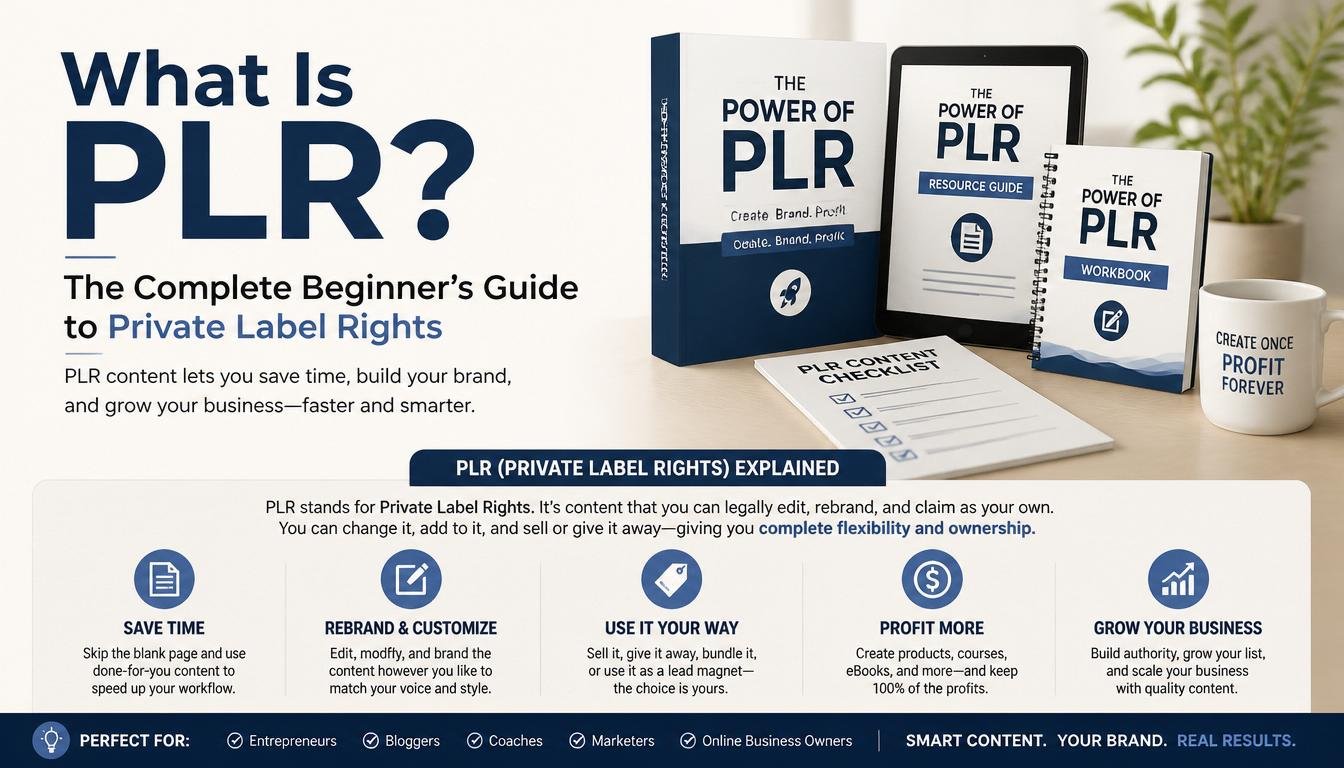

Private Label Rights, usually shortened to PLR, is a type of content license that allows a buyer to modify, brand, and publish content created by someone else. Instead of starting every article, ebook, worksheet, or digital resource from a blank page, the buyer receives ready-made material together with specific permission to use it under their own name or business.
For beginners, PLR can seem confusing because the term refers to both the content and the rights attached to it. A file by itself is not automatically PLR. It becomes PLR only when the creator or seller grants a license that clearly explains what the buyer may and may not do with the material.
Understanding that distinction is the foundation of using PLR responsibly. The content may look similar to an ordinary ebook or article, but the license changes how it can be edited, published, packaged, and presented.
What Does PLR Mean?
PLR stands for Private Label Rights. The phrase “private label” comes from the idea of taking a product made by one creator and presenting it under another brand. PLR applies a similar concept to digital content.
When you purchase PLR, you are not normally buying exclusive ownership of the original work. You are purchasing a license that grants broader permissions than you would receive with ordinary copyrighted content. Depending on the license, you may be allowed to change the title, rewrite sections, add your logo, insert examples, remove outdated information, and publish the finished version as part of your brand.
Every seller can set different rules. One PLR package may allow extensive editing and commercial use, while another may restrict where the content can be published or how it can be distributed.
This is why the license is just as important as the content itself.
The Basic Idea Behind Private Label Rights
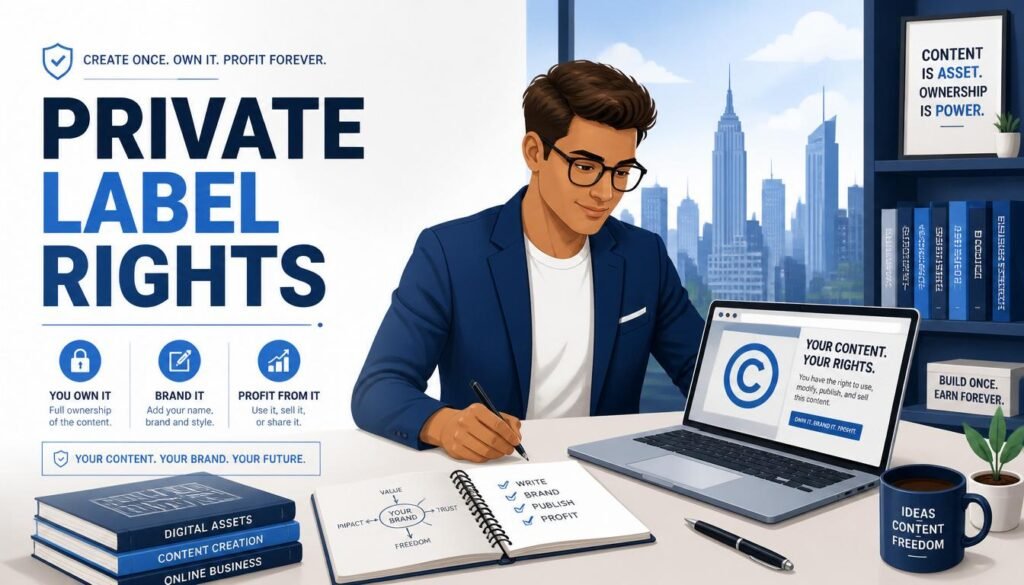
The simplest way to understand PLR is to think of it as a content starting point.
A traditional content creator begins with research, planning, outlining, drafting, editing, formatting, and design. PLR shortens that process by giving the buyer material that has already been developed. The buyer can then adapt the content to match a particular audience, voice, website, product, or marketing goal.
PLR is not the same as copying random content from the internet. Online articles, books, images, and courses are normally protected by copyright, even when they are easy to access. PLR is different because the owner has deliberately issued a license that grants specific reuse and editing permissions.
The buyer is still responsible for following the license. Purchasing a PLR package does not automatically remove every restriction, and it does not mean the buyer can ignore trademarks, privacy rules, advertising standards, or the rights of third parties.
A good beginner mindset is to treat PLR as licensed raw material rather than completely unrestricted content.
What Makes PLR Different From Ordinary Content?
Most content is sold for personal consumption. When someone buys a conventional ebook, they usually receive permission to read it, download it, and perhaps print a copy for themselves. They do not receive permission to replace the author’s name, edit the chapters, place their own logo on the cover, or publish the book on their website.
PLR is designed differently. Its value lies in the additional permissions provided by the creator.
The buyer may be able to transform the material into something that fits a new brand. This can include changing the writing style, reorganizing sections, updating facts, adding personal insights, replacing graphics, or combining the material with original content.
However, PLR is not automatically exclusive. The same package may be sold to many buyers. Two businesses could therefore begin with the same source material. Their finished results may look very different if each buyer substantially edits and personalizes the content, or nearly identical if neither buyer makes changes.
PLR offers flexibility and convenience, but differentiation usually depends on the work added after purchase.
The Role of the PLR License
The PLR license is the document or set of terms that controls how the content may be used. It may appear inside the download folder, on the product page, in a text file, or within the seller’s terms and conditions.
Before using any PLR content, a buyer should locate and read the complete license. Saving a copy is also wise because product pages and seller policies can change over time.
A typical license may address whether the content can be edited, whether the buyer can claim authorship, whether the material can be published online, whether it can be included in a paid product, and whether it can be shared with clients or customers.
Some licenses also include important restrictions. The buyer may be prohibited from selling the unchanged source files, transferring the PLR rights to another person, submitting the content to certain marketplaces, giving it away publicly, or using the seller’s name and branding.
There is no universal PLR license that applies to every product. Similar-looking packages can carry very different rules. Beginners should avoid relying on assumptions based on previous purchases.
The safest rule is simple: read the license attached to the specific product you intend to use.
Ownership and Authorship in PLR
PLR can create confusion around ownership because the buyer may be allowed to publish edited content under a personal or business name. That permission does not necessarily mean the buyer becomes the original copyright owner of the unedited source material.
In many cases, the original creator retains copyright while granting buyers a broad license. The buyer receives permission to use and modify the work within stated limits, but cannot prevent other licensed buyers from using the same original package.
Some sellers allow buyers to identify themselves as the author of the finished version. Others permit branding but prohibit false claims about creating the original source. A license may also require substantial modification before the buyer adds an author name.
These differences matter when building a credible brand. Even when authorship claims are permitted, publishing untouched content under your name can create quality and reputation problems. Readers expect an author or publisher to stand behind the accuracy, originality, and usefulness of what they release.
A responsible PLR buyer reviews the content carefully and takes ownership of the finished reader experience, even when the starting material was created elsewhere.
PLR Is a License, Not a Quality Standard
The term PLR describes usage rights. It does not guarantee that the content is accurate, well written, original, current, or suitable for a specific audience.
High-quality PLR can be thoroughly researched, professionally edited, logically structured, and easy to customize. Poor-quality PLR may contain repetitive writing, vague explanations, outdated advice, factual errors, awkward formatting, or content generated without meaningful quality control.
Beginners sometimes assume that a polished sales page proves the quality of the files inside.
Whenever possible, review samples before buying. Look at the clarity of the writing, depth of the information, organization, grammar, tone, and relevance. Consider whether the content provides a strong foundation or would require a complete rewrite.
After purchase, fact-check important claims and check whether references, statistics, software instructions, prices, laws, platform features, or industry practices are still current. Content involving health, finance, law, safety, or regulated topics requires especially careful review.
PLR saves creation time only when the starting material is reliable enough to improve.
Why Customization Matters
Customization is what turns generic PLR into branded content.
A buyer who publishes PLR exactly as received may end up with material that looks identical to content on other websites. It may also contain a tone, message, design, or level of detail that does not match the intended audience.
Effective customization begins with purpose. Before editing, decide who the content is for, what problem it should address, and what action the reader should take afterward. Those decisions guide every change.
The opening can be rewritten to reflect the reader’s situation. Examples can be replaced with ones relevant to the niche. Explanations can be expanded where beginners need more help. Unnecessary sections can be removed. Original opinions, case studies, screenshots, data, stories, and practical tips can be added.
Branding is more than placing a logo on a cover. It includes vocabulary, tone, formatting, visual style, promises, values, and the overall experience created for the reader.
The more thoughtfully PLR is adapted, the less it feels like a purchased template and the more it becomes a useful part of a distinctive content library.
How to Evaluate PLR Before Using It
A beginner should evaluate both the content and the seller.
Start with the subject matter. The material should match the needs and knowledge level of the intended audience. A package can be well written and still be unsuitable if it is too basic, too advanced, too broad, or focused on the wrong market.
Next, examine the date and context. Some subjects remain useful for years, while others change quickly. A guide about a software platform, online advertising system, tax rule, or fast-moving technology may require frequent updates.
Review the writing for substance. Good PLR should explain ideas clearly rather than filling pages with repeated statements. Headings should follow a logical order, and each section should contribute something meaningful.
Check the seller’s reputation, support information, refund policy, licensing terms, and product description. Clear sellers explain exactly what is included and make the license available before or immediately after purchase.
Finally, estimate the amount of work required. A low-priced package is not a bargain if correcting it takes longer than creating original content. The best PLR purchase is not always the cheapest. It is the one that gives you a dependable foundation you can confidently improve.
Common Beginner Mistakes With PLR
One common mistake is downloading content and publishing it immediately. This skips essential steps such as proofreading, fact-checking, formatting, and adapting the message to the audience.
Another mistake is losing the license. Without the original terms, it may become difficult to prove what permissions were granted or remember important restrictions. Keep the license together with the source files and record where and when the package was purchased.
Beginners may also combine files from different sellers without tracking their separate rules. Each component can carry its own license. An ebook, cover image, template, and stock photo included in one folder may not all have identical permissions.
A further mistake is assuming that editing a few words creates a unique, high-quality product. Meaningful customization usually requires more than changing the title or replacing a handful of sentences.
Finally, some buyers focus entirely on quantity. A library containing thousands of files may appear valuable, but usefulness depends on relevance, quality, organization, and the ability to turn the material into something readers genuinely need.
What Is PLR in Simple Terms?
In simple terms, PLR is content sold with permission to rebrand and modify it according to a specific license.
It gives creators, publishers, marketers, and business owners a prepared foundation instead of forcing them to begin every project from zero. The buyer can shape that foundation into content that matches a particular brand and audience, provided every use stays within the license terms.
The most important points to remember are that PLR is not automatically exclusive, not automatically unrestricted, and not automatically high quality. The rights depend on the seller’s license. The value depends on the quality of the source material and the improvements made by the buyer.
Final Thoughts
Understanding what PLR is begins with separating the content from the license. The files provide the material, while the license provides permission.
Private Label Rights can make content creation more efficient, but it works best when approached professionally. Read the terms, evaluate the quality, verify the information, preserve the license, and customize the material with care.
A strong PLR user does not simply replace a name and publish. They turn a licensed starting point into something accurate, useful, relevant, and consistent with their brand.
That is the real meaning of PLR: not effortless ownership of someone else’s work, but permission to build something valuable from a flexible content foundation.
0 Comments