
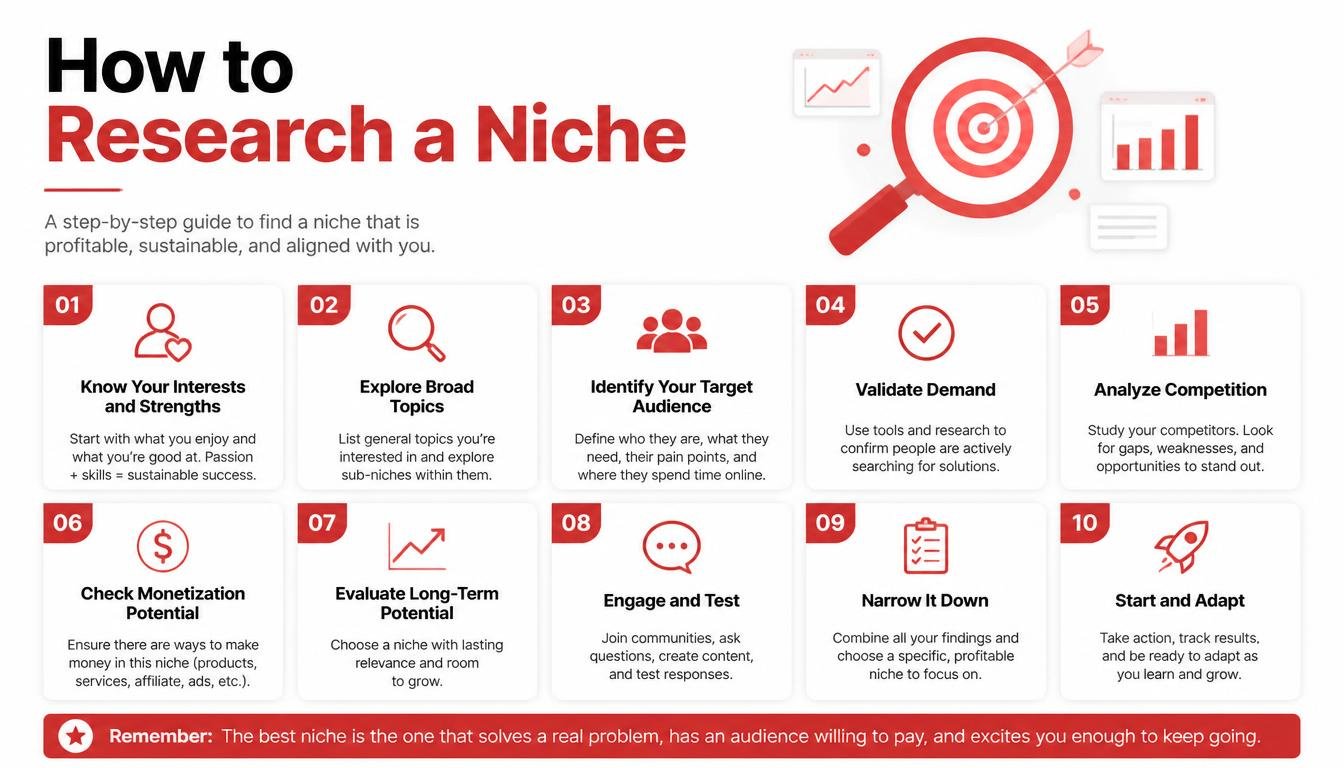

What Is Niche Research?
Niche research is the process of studying a specific market to understand whether it has a real audience, genuine demand, and opportunities for growth. It involves looking at the people interested in the niche, the problems they need solved, what they search for online, the competition already serving the market, the products and services being purchased, the potential to make money, and the opportunities available in the long term. In simple terms, niche research helps you understand what is happening inside a market before you decide to build a business around it. Choosing a niche based only on personal interest is not enough because you may enjoy a topic that has very little demand, weak purchasing activity, or too much competition. Research allows you to combine your interests with actual market evidence and make a more informed decision.
Why Should You Research a Niche Before Starting?
Researching a niche before starting can help you avoid making expensive mistakes and wasting time on a market with limited potential. Without proper research, you may choose a niche with little demand, enter a market that is too competitive, or target an audience that is not interested in what you have to offer. You could also spend months creating content that nobody needs or searches for, only to discover that the niche has very few opportunities to make money. Research can reveal whether people are actively looking for solutions, what problems they have, who your competitors are, and what products or services they are already purchasing. By doing this research before committing significant time and resources, you can identify potential problems early and choose a niche with a stronger foundation for growth.
Start With a Niche Idea
A niche idea can come from many different places, and you do not need to have the perfect business idea before you begin researching. Your interests can provide ideas for topics you naturally enjoy, while your skills and experience can reveal areas where you already have useful knowledge. You can also look at problems you have personally solved, because your experience may help you understand the needs of others facing similar challenges. Questions people ask you can reveal common concerns and potential content opportunities, while existing products and services can show you markets where people are already spending money. Trending topics can also provide ideas, particularly when they are connected to a larger market with long-term potential.
The important thing to remember is that your initial niche idea is only the starting point for research. Just because you are interested in a topic or notice that something is trending does not automatically mean it is a good niche. The next step is to investigate the market, audience, demand, competition, search behavior, profitability, and long-term potential to determine whether the idea is actually worth pursuing.
Start With a Niche Idea
A niche idea can come from many different places, and you do not need to have the perfect business idea before you begin researching. Your interests can provide ideas for topics you naturally enjoy, while your skills and experience can reveal areas where you already have useful knowledge. You can also look at problems you have personally solved, because your experience may help you understand the needs of others facing similar challenges. Questions people ask you can reveal common concerns and potential content opportunities, while existing products and services can show you markets where people are already spending money. Trending topics can also provide ideas, particularly when they are connected to a larger market with long-term potential.
The important thing to remember is that your initial niche idea is only the starting point for research. Just because you are interested in a topic or notice that something is trending does not automatically mean it is a good niche. The next step is to investigate the market, audience, demand, competition, search behavior, profitability, and long-term potential to determine whether the idea is actually worth pursuing.
Define Your Niche Clearly
Before you begin researching a niche, it is important to define exactly what you are researching. Many beginners start with topics that are far too broad, making it difficult to identify a specific audience, understand their problems, or find useful opportunities. A niche can be narrowed down gradually by moving from a broad market to a more specific focus. For example, Health → Fitness → Home Fitness → Home Fitness for Beginners → Home Fitness for Busy Professionals. Each step identifies a more specific audience and set of needs. “Health” covers an enormous range of subjects, while “Home Fitness for Busy Professionals” gives you a much clearer idea of who you are targeting and what type of problems your content or products should solve. Defining your niche clearly makes the rest of your research more focused and useful.
Identify Your Target Audience
Researching a niche is not just about studying a topic; it is about understanding the people behind the market. A niche becomes much easier to serve when you know who your audience is, what they want, what problems they face, and what they are willing to spend money on. Start by identifying who they are, including factors such as their age or life stage, experience level, occupation, interests, lifestyle, and other characteristics that may influence their needs. Then determine what they want, such as achieving a goal, learning a skill, saving money, becoming healthier, or solving a specific problem.
Next, research the problems they have and the questions they ask. Search engines, forums, social media communities, reviews, and comments can reveal the issues people are actively trying to solve. Finally, consider what they are willing to spend money on, including products, services, courses, subscriptions, software, or digital products. You should also pay attention to their buying habits and preferred content formats, such as blog posts, videos, podcasts, social media posts, ebooks, or online courses. The more clearly you understand your audience, the easier it becomes to create relevant content, choose suitable products, and build a business that genuinely serves their needs.
Check Search Demand
Search behavior is one of the most useful ways to research a niche because it provides evidence of what people are actively looking for online. Instead of relying only on assumptions about what might be popular, you can study the searches people make to discover their interests, questions, problems, and needs. Start by searching for the main keyword and examining the results and suggestions that appear. Then look at related searches to uncover connected topics and discover how people describe what they need. Long-tail keywords are especially useful because they often reveal more specific questions and show exactly what users are trying to find. You can also review “People Also Ask” results to uncover common questions and use search trends to determine whether interest in the topic is growing, stable, seasonal, or declining. Search demand does not have to be enormous for a niche to be successful. A smaller niche can still be valuable when it attracts a specific audience with strong needs and a willingness to spend money on solutions.
Use Google Trends to Research a Niche
Google Trends can help you understand how interest in a niche changes over time and whether people are consistently searching for the topic. Start by searching for the main topic and reviewing the interest graph to see whether searches are increasing, declining, or remaining relatively stable. You can then compare multiple topics to see which has stronger or more consistent interest, explore related topics to discover additional niche ideas, and check seasonal patterns to determine whether interest rises and falls at particular times of the year. Finally, look for long-term stability rather than focusing only on a temporary spike in attention.
It is important to understand the difference between evergreen interest and temporary trends. Evergreen topics maintain relatively consistent interest because people continue to have the same needs or problems over time, such as personal finance, cooking, fitness, or gardening. Temporary trends may experience a sudden surge in searches because of a viral event, new product, news story, or short-lived fad, but interest can disappear just as quickly. A strong niche can sometimes benefit from trends, but for a long-term business, it is generally safer to build around a topic with lasting demand and use trends as additional content opportunities.
Research Your Niche on Google
Google can be a simple but powerful tool for researching a niche because the search results can reveal what people are looking for, what solutions already exist, and how competitive the market may be. Start by searching combinations such as “niche + guide,” “niche + tips,” “niche + problems,” “niche + products,” “niche + course,” and “niche + services.” You can also search “best niche products” or “how to solve [problem]” to uncover buying opportunities and specific problems people need help with. As you review the results, look for established websites, blogs, businesses, online stores, courses, videos, forums, and other content serving the same audience. Pay attention to the types of questions being answered, the products being promoted, the topics that appear repeatedly, and whether search results are filled with major authoritative websites or smaller niche-focused sites. These patterns can help you identify demand, competition, content opportunities, customer problems, and potential ways to make money within the niche.
Find the Questions People Ask
One of the best ways to research a niche is to find the questions people are already asking. Tools and platforms such as Google autocomplete, People Also Ask, Reddit, Quora, YouTube comments, Facebook groups, forums, and product reviews can reveal the exact problems, frustrations, concerns, and goals of your potential audience. Look for questions that appear repeatedly across different platforms, especially questions that are specific or difficult to answer. Repeated questions often reveal content opportunities and customer problems because they show that multiple people are looking for the same information or solution. These questions can then be turned into blog posts, videos, guides, social media content, FAQs, courses, or products that directly address what your audience wants to know.
Research Your Competitors
Competition is not automatically a bad thing when researching a niche. In many cases, competition is actually evidence that there is an established audience and that businesses are successfully serving the market. The goal is not to find a niche with no competitors, but to understand who is already operating in the space and identify opportunities for you to do something differently or better.
Start by looking for major websites, smaller niche websites, bloggers, YouTube channels, online communities, product sellers, coaches, and service providers related to your topic. Study what they are doing and look for patterns across the market. Analyze what topics they cover, what products or services they sell, what keywords they appear to target, how they make money, and what types of content their audience responds to. Pay particular attention to their strengths and weaknesses. Look for questions they do not answer, audiences they do not serve, products they do not offer, or topics they cover poorly. These gaps can provide valuable opportunities for your own business and help you develop a unique angle within the niche.
Find Content Gaps
Finding content gaps means looking for information that already exists but is incomplete, outdated, unclear, or not useful enough for the audience. When reviewing competitor websites and content, look for outdated articles, poor explanations, missing beginner or advanced content, weak examples, a lack of practical templates, poor visual content, and questions that are not answered properly. These gaps can reveal opportunities to create something more useful and valuable. The goal is not simply to produce more information, because adding another article that says the same thing may not provide much value. Instead, focus on creating better information by explaining concepts more clearly, providing current examples, offering practical steps, adding useful visuals or templates, and answering questions competitors have overlooked. This approach can help your content stand out while giving readers a better reason to choose your website or business.
Check Niche Competition
When researching a niche, it is important to consider both search competition and business competition. Search competition refers to how difficult it may be to rank your content in search engines, while business competition looks at how many companies, creators, and sellers are already competing for customers. Examine the number of established competitors, the strength of their websites, the quality of their existing content, their brand recognition, and the products or services already available. You should also consider how difficult it may be to rank for important keywords and whether established competitors dominate the market. However, high competition does not automatically mean you should avoid the niche. Look for opportunities to differentiate yourself through a more specific audience, better content, a unique approach, improved products, or by solving problems that existing competitors are not addressing well.
How Much Competition Is Too Much?
There is no specific number of competitors that automatically makes a niche too competitive. A highly competitive niche can still be a good opportunity when you have a specific angle, clearly defined audience, or unique offer that helps you stand out. Instead of asking whether a niche has too many competitors, consider whether you can realistically compete and provide something valuable that existing businesses are not offering. For example, rather than targeting the broad fitness market, you could focus on home fitness for busy professionals over 40 and create simple workout plans designed around their specific needs. The key is finding a position where there is enough demand to support a business while still giving you a realistic opportunity to attract and serve your own audience.
Research Products and Buying Intent
When researching a niche for a business, it is important to determine whether people are actually willing to spend money in the market. You can look for evidence of commercial demand by checking platforms and businesses such as Amazon, Etsy, online stores, course platforms, software marketplaces, service businesses, affiliate programs, memberships, and consulting or coaching providers. Look at the types of products and services being sold, the number of options available, customer reviews, pricing, and whether businesses appear to have an active customer base. If you find many products, services, subscriptions, courses, or other paid solutions being purchased within a niche, it is a strong indication that people are willing to spend money to solve problems or achieve goals related to that market. These signals can help you identify potential monetization opportunities and determine whether a niche has genuine commercial demand, rather than simply attracting people who are interested but unlikely to become customers.
Research Products and Buying Intent
When researching a niche for a business, it is important to determine whether people are actually willing to spend money in the market. You can look for evidence of commercial demand by checking platforms and businesses such as Amazon, Etsy, online stores, course platforms, software marketplaces, service businesses, affiliate programs, memberships, and consulting or coaching providers. Look at the types of products and services being sold, the number of options available, customer reviews, pricing, and whether businesses appear to have an active customer base. If you find many products, services, subscriptions, courses, or other paid solutions being purchased within a niche, it is a strong indication that people are willing to spend money to solve problems or achieve goals related to that market. These signals can help you identify potential monetization opportunities and determine whether a niche has genuine commercial demand, rather than simply attracting people who are interested but unlikely to become customers.
Find the Problems People Are Willing to Pay to Solve
One of the most valuable parts of niche research is identifying problems that people are not only interested in solving, but are also willing to spend money to solve. A useful way to approach this is to connect the Problem → Desired Result → Product or Service Opportunity. Start by identifying a specific problem your audience experiences, then determine what result they want instead. From there, consider what products or services could help them achieve that result. For example, the problem might be that beginners struggle to organize container gardens, while the desired result is to successfully grow vegetables in a small space. This could create opportunities for an eBook, gardening course, printable planner, gardening tools, or affiliate products. This approach helps you move beyond simply finding keywords and instead identify real customer needs that can become profitable business opportunities.
Research Niche Monetization Opportunities
When researching a niche, you should consider how the business could generate income from the audience you attract. Different niches can support different monetization methods, including digital products, physical products, affiliate marketing, advertising, courses, coaching, consulting, memberships, services, sponsorships, and paid newsletters. For example, a business niche might sell an ebook, recommend relevant products through affiliate links, offer a paid course, provide consulting services, or generate advertising revenue from website traffic. A niche does not need to support every possible monetization method to be profitable. Instead, it needs at least a few realistic options that fit the audience, their needs, and their willingness to pay. The more naturally your monetization methods align with the problems your audience wants solved, the stronger the business opportunity can be.
Check Whether the Niche Has Enough Content Opportunities
Before committing to a niche, make sure there are enough topics to support your content strategy over the long term. A niche may have strong demand and profitable products but still be too narrow if you quickly run out of useful things to publish. Ask yourself whether you can come up with 50 or more useful article topics, including both beginner and advanced questions. Look for seasonal topics, products that can be reviewed, common problems that need solutions, and related subtopics or niches that you could eventually explore. A strong niche should give you room to create different types of content while continuing to provide value to your audience. The more depth a niche has, the easier it is to build a website, grow an audience, and expand into new products and opportunities over time.
Research Niche Trends and Long-Term Potential
When researching a niche, it is important to understand whether interest is likely to continue over time or whether the market depends mainly on short-term trends. Evergreen niches address needs that remain relevant for many years, such as personal finance, cooking, fitness, education, or home improvement. Trend-driven niches, on the other hand, are influenced by temporary events, viral topics, new technologies, or changing consumer interests and can experience rapid increases and decreases in demand. To evaluate a niche’s long-term potential, examine its historical interest, current growth, seasonal demand, new products, technology changes, consumer behavior, and broader industry developments. A niche does not have to be completely evergreen to be valuable, but understanding these patterns helps you determine whether you are building around lasting demand or relying heavily on a temporary spike in interest.
Research the Niche on Social Media
Social media platforms can provide valuable insight into what people are interested in, talking about, and struggling with within a niche. Explore platforms such as Facebook, Reddit, YouTube, TikTok, Instagram, Pinterest, and LinkedIn and look for popular discussions, frequently asked questions, complaints, product recommendations, viral topics, audience language, and unanswered questions. Pay attention to the words people use when describing their problems, the topics that receive the most engagement, and the products or solutions people recommend to one another. Comments can be especially useful because they often reveal questions and frustrations that are not obvious from the original post or video. This research can help you understand your audience more naturally, discover content ideas, identify customer problems, and find opportunities that competitors may have overlooked.
Research Niche Reviews and Complaints
Reviews and complaints can be one of the most valuable sources of niche research because they reveal what customers actually like, dislike, struggle with, and wish were better. Study Amazon reviews, Google reviews, Reddit complaints, app reviews, course reviews, and product reviews to find recurring frustrations and unmet needs. Pay particular attention to phrases such as “I wish…,” “The problem is…,” “I can’t find…,” and “Why doesn’t anyone…?” These comments often reveal specific problems that existing products, services, or content are not solving effectively. Repeated complaints can become valuable clues for finding content gaps, product opportunities, and underserved customer needs, giving you a clearer idea of where you may be able to create something better.
Check the Profit Potential of Your Niche
A niche’s profitability should be based on evidence rather than assumptions. A topic may seem profitable because you see successful businesses in the market, but you should evaluate whether the opportunity is strong enough for your own business. One simple method is to score each potential niche from 1 to 10 across several important factors:
| Factor | Score 1–10 |
|---|
| Audience demand |
| Search interest |
| Competition |
| Buying intent |
| Product opportunities |
| Content opportunities |
| Long-term potential |
| Personal knowledge |
For each factor, give the niche a realistic score based on your research. For competition, a higher score should represent a more favorable level of competition—for example, a niche with manageable competition might receive a 9, while a market dominated by extremely strong competitors might receive a 3. Add the scores together and compare the results across several potential niches. This does not guarantee that the highest-scoring niche will be the most successful, but it provides a structured way to compare opportunities and identify niches with a stronger combination of demand, commercial potential, content opportunities, manageable competition, and long-term viability.
Research a Niche Using Free Tools
You do not need expensive software to research a niche effectively. A range of free tools and platforms can provide valuable information about search demand, audience questions, competition, content opportunities, products, and trends. Google can be used to manually research competitors, questions, products, and related topics, while Google Trends helps you examine interest over time and identify seasonal or growing topics. Google Keyword Planner can provide keyword ideas and search-related data, and Google Search Console can show what people are already searching for when they discover your website. Reddit and YouTube are useful for finding real audience questions, discussions, complaints, and popular content, while AnswerThePublic can uncover questions and phrases people search around a topic. Google autocomplete can reveal common search suggestions, and Amazon and Etsy can help you research products, customer reviews, pricing, and buying demand. Pinterest can also provide insight into popular topics, search ideas, and visual content trends. By combining several of these tools rather than relying on just one, you can build a much clearer picture of whether a niche has genuine potential.
Create a Simple Niche Research Spreadsheet
A simple niche research spreadsheet can help you organize your findings and compare different niche ideas before making a final decision. Instead of keeping research scattered across bookmarks, notes, and documents, record the most important information in one place. You can copy the following table into a spreadsheet and fill it in as you research:
| Research Area | What to Record |
|---|
| Niche | Main topic |
| Target audience | Who it serves |
| Main problems | Problems people have |
| Keywords | Important searches |
| Competitors | Main competitors |
| Products | Products being sold |
| Monetization | Ways to make money |
| Content opportunities | Topics to cover |
| Search demand | Evidence of interest |
| Competition | Low / Medium / High |
| Long-term potential | Low / Medium / High |
As you research, try to record specific evidence rather than vague assumptions. For example, instead of writing “high demand,” note the keywords, discussions, products, or trends that indicate people are interested. Once you have completed the spreadsheet for several niche ideas, you can compare them side by side and identify which opportunities have the strongest combination of audience demand, commercial potential, content opportunities, manageable competition, and long-term potential.
A Step-by-Step Niche Research Process
A structured niche research process makes it easier to compare opportunities and avoid choosing a market based on assumptions. Rather than researching one idea and immediately committing to it, start with several possibilities and evaluate each using the same criteria. The following ten steps provide a practical framework you can use for almost any niche.
Step 1: Choose 3–5 Niche Ideas
Start by writing down three to five potential niche ideas based on your interests, knowledge, experience, problems you understand, or markets you have noticed. Do not worry about choosing the perfect idea at this stage. The goal is to create a shortlist that you can research and compare.
Step 2: Define the Audience
For each niche, identify exactly who you would serve. Consider their age or life stage, experience level, interests, goals, problems, lifestyle, buying habits, and preferred content formats. A clearly defined audience makes it easier to understand what the market needs.
Step 3: Identify Problems
Research the problems, questions, frustrations, and goals your target audience has. Look at search results, forums, social media, reviews, comments, and communities to discover what people are trying to solve. Focus especially on problems that appear repeatedly and have practical solutions.
Step 4: Check Search Demand
Search the main keywords and related topics to determine whether people are actively looking for information about the niche. Use search suggestions, related searches, keyword tools, “People Also Ask,” and search trends to identify important topics and long-tail searches. Remember that a niche does not need massive search volume if it attracts a specific audience with valuable needs.
Step 5: Research Competitors
Identify the websites, businesses, bloggers, YouTube channels, creators, product sellers, coaches, and service providers already operating in the niche. Study their content, products, keywords, audience, pricing, and monetization methods. Competition can be a positive sign because it can demonstrate that demand already exists.
Step 6: Find Content Gaps
Look for areas where existing competitors are not providing enough value. This could include outdated information, weak explanations, missing beginner guides, missing advanced content, unanswered questions, poor examples, or a lack of useful templates and visuals. Focus on creating better information, not simply producing more of the same content.
Step 7: Check Products and Buying Intent
Research whether people are spending money in the niche. Look at online stores, marketplaces, courses, software, memberships, services, affiliate products, and other paid solutions. Pay attention to customer reviews, pricing, product variety, and recurring complaints. These signals can help confirm whether the audience has genuine commercial intent.
Step 8: Research Trends
Use tools such as Google Trends and social platforms to determine whether interest in the niche is growing, stable, seasonal, or declining. Look at historical interest, current growth, new products, technology changes, consumer behavior, and industry developments. Ideally, your niche should have enough lasting demand to support your business beyond a temporary trend.
Step 9: Check Monetization Options
Determine how you could realistically make money from the niche. Consider digital products, physical products, affiliate marketing, advertising, courses, coaching, consulting, memberships, services, sponsorships, or paid newsletters. You do not need every monetization method; having several realistic options that fit the audience is usually enough.
Step 10: Score and Compare the Niches
Finally, score each niche using the information you collected. You could rate factors such as audience demand, search interest, competition, buying intent, product opportunities, content opportunities, long-term potential, and personal knowledge from 1 to 10. Compare the totals and review the evidence behind each score. The goal is not simply to choose the niche with the highest number, but to identify the opportunity that offers the strongest overall balance of demand, profitability, manageable competition, content potential, and long-term viability.
By following these ten steps, you move from a simple niche idea to a research-backed decision. The process helps you understand not only whether people are interested in a topic, but also whether there are real problems to solve, customers to serve, content to create, and opportunities to build a sustainable business around.
Example of Niche Research
A complete example can make the niche research process much easier to understand. Let us use Container Gardening for Beginners as the example and walk through the major areas of research.
Niche: Container Gardening for Beginners
Target audience:
The target audience could include beginners who want to grow vegetables, herbs, flowers, or fruits but have limited outdoor space. This could include apartment residents, people with balconies or patios, renters, older adults, and anyone who wants a simple introduction to gardening. Beginners are likely to need straightforward instructions, affordable solutions, and guidance on choosing containers, soil, plants, and basic gardening equipment.
Common problems:
Potential problems include not knowing which plants grow well in containers, choosing the wrong pot size, poor drainage, overwatering or underwatering, selecting unsuitable soil, dealing with pests, finding enough sunlight, and keeping plants alive throughout the growing season. Beginners may also struggle with deciding what to grow and how to organize a small gardening space.
Search topics:
Potential search topics include best vegetables for container gardening, container gardening for beginners, how often to water container plants, best soil for container gardening, vegetables that grow well in pots, container garden ideas for balconies, best containers for growing vegetables, and how to grow tomatoes in containers. These topics provide opportunities to create educational content around specific questions and problems.
Competitors:
Competitors could include established gardening websites, smaller gardening blogs, YouTube gardening channels, Pinterest creators, online gardening stores, nurseries, and gardening product brands. Researching these competitors would reveal which topics they cover, which products they recommend, what types of content attract engagement, and where their information may be incomplete or outdated.
Products:
There are many products connected to this niche, including plant pots, raised containers, soil mixes, fertilizers, seeds, gardening tools, watering equipment, grow lights, plant supports, pest-control products, and gardening planners. The variety of products is a positive sign because it suggests that customers already spend money on solutions related to container gardening.
Content opportunities:
A website could create beginner guides, plant-specific tutorials, container size guides, seasonal planting calendars, product reviews, troubleshooting articles, comparison guides, balcony gardening ideas, printable checklists, and step-by-step tutorials. More advanced content could eventually cover topics such as succession planting, companion planting, container soil management, and maximizing yields in small spaces.
Monetization options:
Several monetization methods could work in this niche, including affiliate marketing, advertising, digital products, physical products, sponsored content, courses, and memberships. For example, a website could recommend gardening equipment through affiliate links, sell a container gardening ebook or planting planner, display advertisements, or eventually develop a paid course for beginners.
Content gaps:
Research may reveal opportunities to provide information that is easier to understand or more practical than existing content. For example, some competitors may provide general gardening advice without explaining exactly which container sizes beginners should use, how many plants can fit in each container, or how to organize a small balcony. Other gaps could include simple beginner checklists, printable planting plans, budget-friendly setups, step-by-step examples, and clear solutions to common beginner mistakes.
Final niche assessment:
Container Gardening for Beginners is a promising niche because it has a clearly identifiable audience, numerous problems to solve, many searchable topics, a wide range of products, and several monetization opportunities. It also has strong content potential because beginners have questions at every stage, from choosing their first container to harvesting their first crop. Competition exists, but there are opportunities to differentiate by focusing specifically on beginners, small spaces, low-cost setups, specific climates, or highly practical step-by-step guidance. Overall, the niche demonstrates a good balance of audience demand, commercial opportunities, content depth, and long-term potential, making it a strong example of how proper niche research can turn a broad idea into a focused business opportunity.
Common Niche Research Mistakes
Niche research can help you make a better decision, but only if you look at the market from several different angles. One common mistake is choosing a niche simply because you like it without checking whether other people are interested in it or willing to spend money on it. You should also avoid ignoring search demand, because a topic may seem interesting while attracting very little attention online. At the same time, being afraid of competition can cause you to overlook profitable markets. Competition often shows that demand already exists, and the real goal is to find a way to compete or differentiate yourself.
Another mistake is looking only at keyword volume. High search volume does not automatically mean a niche is profitable, because those searches may have little commercial intent. You should also investigate buying intent, audience needs, products, services, and existing businesses. Failing to research the audience can lead to content that does not solve real problems. It is also important to avoid choosing a niche that is too broad, which can make it difficult to target a specific audience, or too narrow, which can limit your content and growth opportunities. Finally, do not ignore long-term potential or skip testing the idea. A niche may look promising during initial research, but publishing content, observing audience response, and testing products can provide valuable evidence before you commit significant time and resources.
Niche Research Checklist
Before committing to a niche, use the following checklist to make sure you have researched the market from multiple angles:
-
I know who the niche serves — I can clearly describe my target audience.
-
I understand the audience’s problems — I know their main challenges, questions, frustrations, and goals.
-
People actively search for the topic — There is evidence of genuine interest and search demand.
-
I found relevant keywords — I have identified important keywords, questions, and related search topics.
-
I researched competitors — I know which websites, businesses, creators, and sellers are already serving the market.
-
I found content gaps — I have identified information that could be explained better, expanded, updated, or covered for the first time.
-
I found products or services being sold — There is evidence that people already spend money in the niche.
-
I identified monetization opportunities — I can see realistic ways to generate income from the audience.
-
The niche has enough content ideas — I can identify plenty of useful topics, questions, problems, and subtopics to cover.
-
The niche has long-term potential — The market is likely to remain relevant rather than relying entirely on a short-lived trend.
-
I know how I can differentiate myself — I have a specific audience, approach, expertise, format, offer, or angle that can help me stand out.
The more boxes you can confidently check, the stronger your niche research is likely to be. You do not need every factor to be perfect, but this checklist helps ensure that your decision is based on evidence rather than assumptions.
How to Know When You’ve Researched a Niche Enough
Niche research does not need to give you perfect certainty before you move forward. The purpose of research is to gather enough reliable information to make a reasonable, evidence-based decision. You have generally researched a niche enough when you understand Who → Problem → Demand → Competition → Buying Intent → Monetization → Content Opportunities → Differentiation. You should know who your audience is, what problems they want solved, whether there is genuine demand, who the main competitors are, whether people show buying intent, how you could monetize the market, whether there are enough content opportunities, and what makes your approach different. At that point, continuing to research endlessly may provide diminishing returns. The next step is to test your idea in the real world by creating content, building an audience, or offering a product and using the results to learn and improve.
What to Do After Researching Your Niche
Once you have completed your niche research and gathered enough evidence to make an informed decision, it is time to move from research into action. Start by choosing your niche based on the strongest combination of demand, audience needs, competition, profitability, and long-term potential. Then define your target audience in greater detail so you understand exactly who you are creating for. Next, build a keyword list containing your main keywords, long-tail searches, questions, and related topics. Use this information to research competitors in more detail, identifying their strongest content, products, marketing strategies, and weaknesses.
With your research organized, you can create your content plan and decide which topics to publish first, followed by developing your first offer such as an ebook, service, course, affiliate recommendation, or other product that solves a specific audience problem. Finally, publish and test your content and offers, paying attention to traffic, engagement, questions, email sign-ups, and sales. Your research gives you a starting point, but real-world feedback helps you improve your strategy over time.
At this stage, you can also continue to the “How to Select a Good Niche” article for additional guidance on evaluating niche opportunities, or explore “200 Niche Ideas for Your Blog” to discover potential markets to research and build around.
Frequently Asked Questions
How do I research a niche?
To research a niche, start by identifying who the niche serves and what problems they want solved. Then check whether people are actively searching for the topic using Google, keyword research tools, Google Trends, social media, forums, and other online communities. Research your competitors to see what content, products, and services already exist, and look for gaps you could fill with better or more useful information. Next, investigate whether people are spending money in the market and identify realistic monetization opportunities such as products, services, affiliate marketing, courses, or advertising. Finally, evaluate the niche’s content potential, competition, long-term demand, and your ability to differentiate yourself. The goal is to gather enough evidence to determine whether the niche has a real audience, real problems, commercial demand, and enough opportunity to build a sustainable business.
What is the best tool for niche research?
There is no single tool that can answer every niche research question, but Google Trends is one of the best free starting points because it lets you compare topics, examine interest over time, and identify seasonal or declining trends. For deeper keyword and competitor research, paid tools such as Ahrefs or Semrush provide more extensive data and analysis. However, the best approach is to combine tools rather than rely on one. A practical free research process can use Google Trends, Google Keyword Planner, Google search results, Reddit, YouTube, Amazon, and social media to evaluate demand, questions, competition, products, and buying intent. The tool is less important than using multiple sources of evidence to determine whether the niche has genuine potential.
How do I know if a niche is profitable?
You can determine whether a niche is profitable by looking for evidence that people have a problem, want a solution, and are willing to spend money to get it. Research existing products, services, courses, subscriptions, affiliate offers, and businesses operating in the niche to see whether there is established buying activity. You should also check search demand, audience size, competition, and the number of realistic ways you could monetize the market. A niche does not need to be huge to be profitable; a smaller, highly targeted audience can be valuable when its problems are specific and commercially important. The strongest signs of profitability are consistent demand, clear customer problems, existing purchases, and multiple realistic opportunities to generate revenue.
How do I find niche demand?
You can find niche demand by looking for evidence that people are actively interested in, searching for, discussing, and spending money on a topic. Start by researching keywords and related searches using Google, Google Trends, and keyword research tools. Then explore Reddit, YouTube, social media, forums, and online communities to see what questions and problems people repeatedly discuss. Finally, check marketplaces such as Amazon, Etsy, and other online stores to see whether people are purchasing products and services related to the niche. Strong niche demand is usually indicated by consistent searches, active discussions, recurring problems, growing interest, and existing buying activity.
How do I research niche competition?
You can research niche competition by searching your main keywords on Google and identifying the websites, businesses, blogs, YouTube channels, creators, product sellers, and service providers already targeting the same audience. Examine the quality of their content, their website authority, the products or services they offer, their pricing, how they monetize, and the level of engagement they receive. Also look for smaller competitors and content gaps, such as unanswered questions, outdated information, or topics that are not covered well. The goal is not to eliminate competition, but to determine how difficult the market is and whether you can find a specific audience, problem, or approach that allows you to compete and stand out.
How many competitors should a niche have?
There is no ideal number of competitors a niche should have. A niche with zero competitors can actually be a warning sign because it may indicate that there is little demand or limited commercial potential. Having several competitors is often positive because it shows that people are interested in the market and businesses are already serving customers. Instead of focusing on the number of competitors, evaluate how strong they are, how well they serve the audience, and whether you can offer something different. A niche can have many competitors and still be a good opportunity when you have a specific audience, unique angle, better content, or a stronger product.
Should I choose a niche with low competition?
Choosing a niche with low competition can be beneficial because it may be easier to attract attention, rank in search results, and establish yourself as an authority. However, low competition should not be the main goal. Extremely low competition can sometimes mean there is little audience demand, weak buying intent, or limited business potential. A better approach is to look for a niche with strong demand, manageable competition, and a clear opportunity to differentiate yourself. The ideal niche is one where you can realistically compete while still serving a valuable audience with useful content, products, or services.
How do I find niche keywords?
You can find niche keywords by starting with your main topic and expanding it into the specific words and phrases your audience uses when searching for information. Begin with Google autocomplete, related searches, and “People Also Ask” to discover common questions and variations. Then use tools such as Google Keyword Planner, Google Trends, Ahrefs, or Semrush to find related keywords, search demand, and longer, more specific phrases. Also research Reddit, YouTube, forums, and social media to discover the language people use when describing their problems. Focus on a mix of main keywords, long-tail keywords, questions, and problem-based searches that are relevant to your audience and can be turned into useful content.
How do I know if people will buy products in my niche?
You can estimate whether people will buy products in your niche by looking for existing evidence of purchasing activity. Search marketplaces such as Amazon and Etsy, online stores, course platforms, software marketplaces, and service businesses to see whether products or services are already being sold successfully. Pay attention to customer reviews, product ratings, pricing, repeated purchases, and the number of competing offers. You can also look for affiliate programs, memberships, coaching, and other paid solutions. If people are actively spending money to solve problems or achieve goals related to your niche, that is a strong indication of buying intent and potential commercial demand.
How long does niche research take?
Niche research can take anywhere from a few hours to several days, depending on how complex the niche is and how deeply you want to investigate it. For a simple niche, you may be able to identify the audience, demand, competition, products, and monetization opportunities within a few hours. More competitive or specialized markets may require several days of research across search engines, social media, marketplaces, competitors, and trend data. The goal is not to spend weeks searching for perfect certainty, but to gather enough reliable information to understand the audience, problems, demand, competition, buying intent, monetization options, content opportunities, and long-term potential before moving forward.
Can I research a niche for free?
Yes, you can research a niche effectively without spending money on expensive tools. Free resources such as Google Search, Google Trends, Google Keyword Planner, Google autocomplete, Reddit, YouTube, social media, Amazon, Etsy, Pinterest, forums, and product reviews can help you understand search demand, audience problems, competition, buying intent, content opportunities, and market trends. Paid tools can provide deeper data and make certain types of research faster, but they are not required to determine whether a niche has potential. By combining several free sources and looking for consistent evidence across them, you can conduct useful and thorough niche research without a large budget.
Can I change my niche later?
Yes, you can change your niche later, especially if your research or real-world results show that the original niche has limited demand, weak monetization opportunities, or is not a good fit for you. However, changing direction can become more difficult after you have built a large website, audience, content library, or brand around a specific topic. It is usually better to research carefully before starting, but you should also remain flexible and be willing to adjust your niche as you learn more about your audience and the market.
Conclusion
Choosing a niche should never be based on a guess or a passing idea. Good niche research helps you understand who your audience is, what problems they need solved, whether there is genuine demand, how much competition exists, whether people are willing to spend money, how you can monetize the market, and whether the niche has enough long-term potential. By researching these areas before committing, you can avoid wasting time on a market with little opportunity and identify ways to create something genuinely valuable.
The goal is not to find a perfect niche with zero competition or guaranteed success. Instead, look for a market with real demand, clear problems, commercial potential, enough content opportunities, manageable competition, and room for you to offer something different. Once you have gathered enough evidence to make an informed decision, stop researching endlessly and put your idea into action. Create content, test your offers, listen to your audience, and improve as you learn. Effective niche research gives you the foundation; execution and continued learning turn that foundation into a real business.

0 Comments