
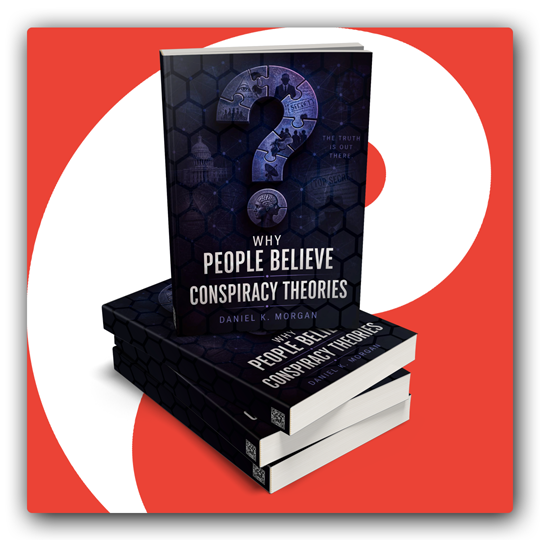
🧠 Why People Believe Conspiracy Theories PLR eBook is a thoughtful guide to conspiracy beliefs, psychology, misinformation, critical thinking, and evidence evaluation. Customize, rebrand, publish, sell, or repurpose this editable PLR eBook according to the included license.
Why People Believe Conspiracy Theories PLR Ebook – 48K Words
Original price was: $27.00.$9.99Current price is: $9.99.
50 in stock
Sale!
Full Description
🧠 Why People Believe Conspiracy Theories PLR eBook
🔍 Help Readers Understand Conspiracy Beliefs Without Ridicule, Panic, or Blind Trust
Why People Believe Conspiracy Theories PLR eBook is a comprehensive, beginner-friendly guide exploring the psychology, identity, emotion, distrust, group influence, media dynamics, misinformation, critical thinking, evidence evaluation, and respectful communication surrounding conspiracy beliefs.
This fully editable Private Label Rights (PLR) eBook gives you a ready-made educational resource that can be customized, rebranded, published, sold, bundled, and repurposed according to the included license.
🌟 Turn a Difficult Subject Into a Clear, Thoughtful Learning Journey
Conspiracy theories are often discussed in extremes.
One side may dismiss believers with ridicule.
Another may treat every suspicious claim as automatically true.
Neither approach helps readers understand why certain explanations become persuasive.
Why People Believe Conspiracy Theories PLR eBook takes a more balanced approach.
It explores why people search for patterns, certainty, meaning, control, identity, and explanations during confusing or threatening situations—while also teaching readers how to distinguish compelling narratives from well-supported evidence.
🎯 What Readers Will Learn
✅ Understand the difference between a real conspiracy, a conspiracy claim, and a conspiracy theory
✅ Explore why uncertainty can increase the appeal of simple explanations
✅ Understand pattern detection and the search for agency
✅ Recognize confirmation bias and other reasoning shortcuts
✅ Explore the role of fear, anger, anxiety, and grievance
✅ Understand how identity and belonging can influence beliefs
✅ Examine distrust and the impact of genuine institutional failures
✅ Understand polarization, group conflict, and scapegoating
✅ Explore social influence, online communities, and echo chambers
✅ Understand how viral digital content can amplify claims
✅ Recognize common persuasive storytelling techniques
✅ Evaluate evidence and competing explanations
✅ Distinguish misinformation, disinformation, and propaganda
✅ Understand potential effects on health, relationships, workplaces, and communities
✅ Communicate respectfully with people holding controversial beliefs
✅ Explore debunking, prebunking, and media-literacy strategies
✅ Build stronger information-evaluation habits
✅ Develop long-term intellectual humility and open-minded skepticism
📚 Inside the 20-Chapter PLR eBook
Chapter 1: Understanding What a Conspiracy Theory Is
Define conspiracy, conspiracy claim, and conspiracy theory while explaining why a label alone cannot determine whether a claim is true or false.
Chapter 2: A Brief History of Conspiracy Thinking
Explore conspiracy narratives across different periods and understand why social disruption, conflict, and uncertainty can encourage them.
Chapter 3: How the Mind Handles Uncertainty
Examine how ambiguity, incomplete information, and the desire for certainty can influence interpretation.
Chapter 4: Pattern Detection and the Search for Agency
Explore why humans naturally look for patterns, causes, intentions, and connections—even when the available evidence is incomplete.
Chapter 5: Cognitive Biases and Reasoning Shortcuts
Introduce confirmation bias, motivated reasoning, availability effects, selective attention, and other cognitive shortcuts that can influence judgment.
Chapter 6: Control, Safety, and the Need for Meaning
Examine how feelings of uncertainty, powerlessness, and unpredictability can make coherent explanations feel especially attractive.
Chapter 7: Identity, Belonging, and the Appeal of Being an Insider
Explore how beliefs can become connected to identity, community, group loyalty, and the feeling of possessing knowledge others supposedly lack.
Chapter 8: Fear, Anger, Anxiety, and Grievance
Understand how strong emotions can affect attention, confidence, blame, information seeking, and reactions to threatening events.
Chapter 9: Trust, Distrust, and Institutional Failure
Explore why distrust develops, why genuine institutional wrongdoing matters, and why skepticism does not have to become total rejection of evidence or expertise.
Chapter 10: Group Conflict, Polarization, and Scapegoating
Understand us-versus-them thinking and how complex problems can become simplified into narratives involving villains, hidden groups, or deliberate sabotage.
Chapter 11: Social Influence, Communities, and Echo Chambers
Explore how people learn from friends, family, communities, creators, and online groups—and how repeated reinforcement can strengthen confidence.
Chapter 12: Digital Media, Virality, and Recommendation Systems
Understand how attention-driven online environments can spread emotionally engaging claims faster than careful verification.
Chapter 13: Persuasive Narratives and Rhetorical Techniques
Identify storytelling patterns involving heroes, villains, hidden knowledge, selective evidence, emotionally loaded questions, and moving standards of proof.
Chapter 14: Evaluating Evidence and Competing Explanations
Learn how to state a claim precisely, trace sources, separate evidence from interpretation, test alternative explanations, and calibrate confidence.
Chapter 15: Misinformation, Disinformation, and Propaganda
Understand the differences between inaccurate information, deliberate deception, persuasive propaganda, and selectively presented facts.
Chapter 16: Consequences for Health, Relationships, and Society
Explore how conspiracy beliefs can affect decision-making, family relationships, workplaces, communities, public trust, and personal wellbeing.
Chapter 17: Talking With Someone Who Believes a Conspiracy Theory
Learn how to listen without automatically agreeing, ask useful questions, reduce unnecessary escalation, and maintain appropriate personal boundaries.
Chapter 18: Debunking, Prebunking, and Media Literacy
Explore strategies for correcting false claims, building resistance to manipulation, encouraging source evaluation, and slowing impulsive sharing.
Chapter 19: Responsible Communication in Schools, Workplaces, and Communities
Learn how organizations can communicate uncertainty, establish evidence-based norms, respond to rumors, and use trusted messengers responsibly.
Chapter 20: Building Long-Term Resilience and Open-Minded Skepticism
Develop a practical information routine based on curiosity, source checking, uncertainty awareness, intellectual humility, and thoughtful skepticism.
🎁 Supporting Resources Included
The eBook includes:
✅ Detailed table of contents
✅ Beginner-friendly psychology and media-literacy explanations
✅ Practical real-world scenarios
✅ Common reasoning mistakes
✅ Best-practice guidance
✅ Chapter summaries
✅ Reflection and action checklists
✅ Conspiracy-theory terminology glossary
✅ Frequently asked questions
✅ Evidence-evaluation framework
✅ Source-checking guidance
✅ Communication strategies
✅ 30-day critical-thinking and media-literacy action plan
✅ Printable quick-reference cheat sheet
⭐ Why This PLR eBook Is Different
Many books about conspiracy theories take an extreme approach.
They may mock believers, dismiss every form of skepticism, or encourage readers to accept claims without sufficient evidence.
Why People Believe Conspiracy Theories PLR eBook takes a more useful middle path.
It recognizes that:
🔎 Real conspiracies can occur
🏛️ Institutions can fail
📢 Media can mislead
🧠 Human reasoning has limitations
👥 Group identity can influence belief
📱 Digital platforms can amplify misinformation
📚 Evidence still matters
The goal is not blind trust or automatic distrust.
The goal is better reasoning.
🧠 Teach Critical Thinking Without Shaming People
The eBook encourages readers to ask:
✅ What exactly is the claim?
✅ What evidence supports it?
✅ Where did the evidence originate?
✅ Can the source be independently verified?
✅ What alternative explanations exist?
✅ What evidence would change the conclusion?
✅ Am I evaluating the claim or protecting my identity?
✅ How confident should I actually be?
These questions help readers become more thoughtful consumers of information without turning skepticism into cynicism.
👥 Ideal Final Readers
✅ Beginners interested in conspiracy beliefs
✅ Students and educators
✅ Families navigating difficult conversations
✅ Media-literacy learners
✅ Community leaders
✅ Communication professionals
✅ Readers interested in psychology
✅ Critical-thinking audiences
✅ People concerned about misinformation
✅ Anyone wanting stronger information-evaluation skills
💼 Ideal PLR Buyers
This PLR eBook is ideal for:
✅ PLR and digital-product sellers
✅ Psychology publishers
✅ Media-literacy educators
✅ Critical-thinking bloggers
✅ Course creators
✅ Coaches and trainers
✅ Membership-site owners
✅ Newsletter publishers
✅ Communication consultants
✅ Personal-development brands
💰 Commercial Uses
Subject to the included PLR license, you can:
✅ Sell the customized finished eBook
✅ Use it as a premium lead magnet
✅ Include it in a critical-thinking course
✅ Add it to a membership library
✅ Create media-literacy worksheets
✅ Build a 30-day information-resilience challenge
✅ Turn chapters into blog posts
✅ Create email lessons
✅ Produce educational videos
✅ Develop workshops and webinars
✅ Create discussion guides
✅ Bundle it with psychology, misinformation, communication, or digital-wellbeing resources
✏️ Private Label Rights Benefits
Subject to the included license, you can:
✅ Edit and rewrite the content
✅ Add your name or pen name
✅ Add your business name and logo
✅ Change the title and subtitle
✅ Design a new cover
✅ Modify colors, fonts, and formatting
✅ Rearrange chapters
✅ Remove or expand sections
✅ Add original examples
✅ Add current research or regional resources
✅ Create worksheets and templates
✅ Add your own case studies
✅ Publish and sell the customized finished eBook
✅ Use it as a course or membership bonus
✅ Repurpose chapters into articles, emails, videos, and presentations
✅ Bundle it with related products
Important PLR Note: The customized finished product may be sold according to the supplied license. The underlying PLR rights are not automatically transferred or resold to customers unless a separate reseller or transferable-rights license expressly permits it.
🔄 Repurposing Ideas
🧠 Critical-thinking mini-course
🔎 Claim-evaluation workbook
📱 Social-media misinformation guide
📋 Source-checking checklist
👨👩👧 Family conversation guide
🏢 Workplace rumor-response guide
📧 30-day media-literacy email course
🎓 Classroom discussion resource
📰 Misinformation-awareness article series
🗣️ Respectful difficult-conversations guide
❓ Frequently Asked Questions
Is this a PLR eBook?
Yes. Why People Believe Conspiracy Theories PLR eBook is an editable Private Label Rights product that can be customized, rebranded, published, sold, and repurposed according to the included license.
Does the eBook promote conspiracy theories?
No. It studies why conspiracy beliefs can become persuasive and teaches readers how to evaluate claims using evidence and competing explanations.
Does it dismiss every conspiracy claim?
No. The guide acknowledges that genuine conspiracies and institutional wrongdoing can occur while explaining why that does not automatically validate every unsupported claim.
Does it diagnose people who hold these beliefs?
No. The content avoids armchair diagnosis, stereotyping, ridicule, and discrimination.
Is it suitable for beginners?
Yes. Psychological, social, media, and reasoning concepts are introduced gradually in accessible language.
Can I add my own research?
Yes. Adding current, properly sourced research can make your customized edition more distinctive.
Can I change the title and cover?
Yes, subject to the included PLR license.
Can I sell the customized eBook?
Yes, subject to the supplied license. Selling the customized product does not automatically transfer the underlying PLR rights.
Can I turn the chapters into a course?
Yes. Subject to the license, chapters can be adapted into lessons, emails, workshops, videos, worksheets, presentations, and other educational materials.
🚀 Create Your Own Critical-Thinking Product
Creating a balanced guide to conspiracy beliefs requires research into psychology, communication, misinformation, media, social influence, and evidence evaluation.
With Why People Believe Conspiracy Theories PLR eBook, you already have a structured foundation.
🧠 Customize the content.
🎨 Add your branding.
📚 Include your own examples.
🔎 Add updated research.
📋 Create companion worksheets.
🎓 Build your course.
📧 Create an email series.
💰 Publish your digital product.
🌟 Customize. Rebrand. Publish. Sell. Repurpose.
Give readers a thoughtful way to understand conspiracy beliefs, evaluate information, communicate across disagreements, and develop stronger critical-thinking habits while creating a versatile educational product for your psychology, media-literacy, communication, or digital-product business.
⚠️ Disclaimer
This product provides general educational information about conspiracy beliefs, psychology, misinformation, critical thinking, and communication. It is not psychological diagnosis, medical advice, mental-health treatment, legal advice, crisis intervention, or professional counseling.
People can hold unusual or controversial beliefs for many different reasons, and no single explanation applies to every individual. Readers should avoid diagnosing others based solely on their beliefs.
Buyers are responsible for reviewing, fact-checking, updating, and appropriately localizing the content before publication. No educational, psychological, health, audience, sales, income, or business result is guaranteed.
🎁 Exclusive Bonuses Included!
When you grab this PLR eBook, you’ll also receive a ready-to-use sales page, a cheat sheet, and a high-quality promotional image—everything you need to sell it quickly and effortlessly!
🔥 LIMITED TIME OFFER! 🔥
Grab this complete PLR eBook for only $9.99— exclusively for the first 50 buyers! Don’t miss your chance to own this 20-chapter guide and claim full PLR rights at this unbeatable price.
License Details:
✅ You Can:
- Sell the product and keep 100% of the profits.
- Edit, rebrand, and modify the content.
- Break the content into smaller reports or guides.
- Bundle with other PLR products.
- Add to paid membership sites or courses.
- Convert into videos, audios, or PDFs.
- Use excerpts for blogs, emails, or free downloads.
❌ You Cannot:
- Pass on PLR, resale, or master resell rights to others.
- Give away the full package for free.
- Offer 100% affiliate commissions.
- Add to previously paid memberships without an extra fee.
PLEASE PAY ATTENTION TO THE LICENSE TERMS MENTIONED ABOVE
If you want to use the content in a way that is not specifically stated within the License, please ask if you can before you do so.
Related products
-
Sale!
Mastering the Art of Airbrushing PLR Ebook – 12K Words
Original price was: $17.00.$9.99Current price is: $9.99. -
Sale!

Air Hockey Mastery – The Ultimate Guide to Strategy, Skill & Competitive Play PLR Ebook
Original price was: $17.00.$9.99Current price is: $9.99. -
Sale!

Clear Skin Blueprint – The Ultimate Guide to Understanding and Treating Acne PLR Ebook – 15k Words
Original price was: $27.00.$9.99Current price is: $9.99.
Reviews